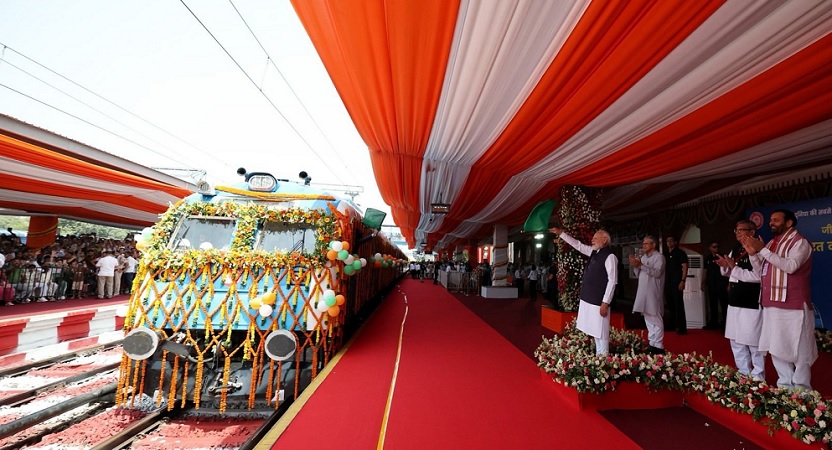

Prime Minister Narendra Modi on Friday inaugurated and laid the foundation stone for development projects worth around ₹14,700 crore in Haryana’s Jind, describing the occasion as a historic milestone for the state and the country. The projects span railways, highways, healthcare and cultural infrastructure, with the highlight being the launch of India’s first hydrogen-powered train.
Addressing a public gathering, the Prime Minister said Jind had permanently secured its place in history with the launch of the country’s first hydrogen-powered train.
“Today, Jind and Haryana have permanently etched their names in the pages of history. From here today, the nation has been gifted its first Hydrogen Train. I congratulate all of you and the entire country for this momentous step related to the deep modernization of Indian Railways,” he said.
Recalling his long association with the region, PM Modi praised Jind’s historical, cultural and spiritual significance. “This is no ordinary land; it is a profound land of history, bravery, religion, and immense pride,” he said, while fondly remembering his early visits to the city and the affection he received from the people, along with local delicacies such as Murrah buffalo dairy products, desi bura and ghevar.
Highlighting Haryana’s development trajectory, the Prime Minister said the state had embarked on a new path of progress in recent years. “Today’s program is filling this exact mission of the government with completely new energy,” he said.
Besides launching the hydrogen-powered train, PM Modi dedicated and laid the foundation stone for projects worth over ₹14,000 crore, including railway, highway, healthcare and cultural infrastructure. He also dedicated Pandit Neki Ram Sharma Government Medical College in Bhiwani and Maharishi Chyavan Medical College along with Rao Tularam Hospital in Narnaul to the nation.
“These new institutions will make the healthcare services of Haryana even more empowered and highly accessible,” PM Modi said. He also appreciated residents for participating in cleanliness drives ahead of the event. “We must systematically make cleanliness an integral part of our everyday lives in this exact manner,” the Prime Minister said.
Hydrogen train marks India’s entry into next-generation rail mobility
Calling hydrogen the fuel of the future, PM Modi said the railway sector had witnessed three distinct technological phases. “The 19th century was fundamentally defined by steam engines while the 20th century was defined by electrical power. The 21st century will be driven by hydrogen mobility. Today, Indian Railways has taken a massive leap in this 21st-century technology, which holds immense potential for future expansion,” he said.
The Prime Minister noted that hydrogen-powered rail technology had emerged globally only seven to eight years ago and was still being adopted by only a handful of countries. “You will be immensely proud to hear about the true capabilities of this newly launched Indian hydrogen train,” he said.
Sharing details of the train, PM Modi said it was the most powerful hydrogen-powered train in the world, equipped with a 3,200-horsepower propulsion system and 10 coaches. “India has successfully demonstrated its prowess by running a hydrogen train with ten full coaches straightaway,” he said, adding that many international hydrogen trains currently operate with only three or four coaches.
The Prime Minister described the train as a major success of the Make in India initiative. “This is a highly successful and proud example of the Make in India initiative,” he said, crediting Indian engineers and domestic manufacturers for designing and developing the train entirely within the country.
PM Modi added that hydrogen-powered railways would require dedicated infrastructure and new industrial ecosystems. “This advanced train network is absolutely guaranteed to create numerous new employment opportunities for the youth of Haryana,” he said.