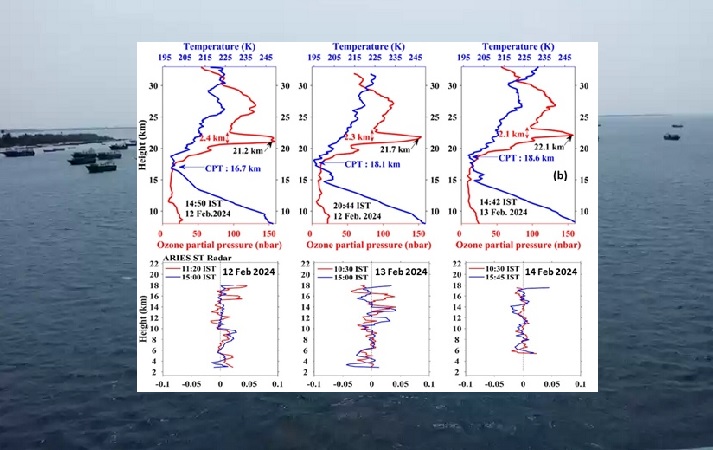

Scientists have detected an unusually high concentration of ozone in the upper atmosphere over the North Bay of Bengal. This unexpected finding is helping researchers better understand how air currents transport ozone through the stratosphere.
The ozone layer, which protects life on Earth by absorbing harmful ultraviolet (UV) radiation from the Sun, normally reaches its maximum concentration at altitudes of about 25–30 km. Researchers have been trying to understand how atmospheric circulation and dynamical processes influence the distribution of ozone in the stratosphere over the Indian region.
Following this quest, scientists from institutions across India, of which the Aryabhatta Research Institute of Observational Sciences (ARIES), an autonomous institute under the Department of Science and Technology (DST), Government of India, was an important participant, used data from a countrywide network of atmospheric radars, weather balloons, satellites, and advanced atmospheric models to conduct an experiment to provide a detailed picture of how ozone moves high above the Earth.
The findings, published in Earth and Space Science by the American Geophysical Union (AGU), provide quantitative experimental evidence of the redistribution of stratospheric ozone over the Indian subtropical region during winter.
The study was carried out as part of the Phase-I NetRAD-ASMA campaign, a nationwide scientific programme that brought together research institutions across India. The campaign aimed to better understand the complex processes taking place in the Earth’s atmosphere. Scientists and researchers from several institutions participated in the campaign, including Dr Manish Naja and Dr Samaresh Bhattacharjee from ARIES.
During the campaign, the indigenously developed 206.5 MHz Stratosphere–Troposphere (ST) Radar at ARIES, Nainital accumulated data alongside similar radars at Haringhata, Gadanki and Kochi.
Researchers also launched weather balloons carrying instruments to measure atmospheric conditions and ozone levels. By collecting data simultaneously from different parts of the country, scientists were able to compare wind patterns and vertical air movements across India, helping them better understand the unusual ozone event and the atmospheric conditions that caused it.
During the campaign, scientists discovered an unusually thick ozone layer about 21 to 23 kilometres above the North Bay of Bengal. The amount of ozone in this layer was much higher than normally seen over eastern India, and the layer remained in place for more than a day. This unexpected discovery raised an important question about the reason behind the accumulation of so much ozone at this altitude.
To unravel the mystery, scientists combined measurements from ozone- and weather-monitoring balloons with observations from a nationwide radar network, the Aura MLS and INSAT-3DR satellites, and advanced atmospheric models. This comprehensive approach helped them identify the processes that led to the formation of the unusual ozone layer.
The enhanced ozone layer was observed during both daytime and nighttime, suggesting that sunlight-driven photochemical processes were unlikely to be its primary cause. Satellite measurements also revealed the unusual ozone structure, supporting the balloon observations. Scientists then examined the roles of convection, atmospheric wind shear, horizontal transport and vertical air motion. The observations revealed persistent downward air motion in the lower stratosphere.
Combining the evidence from different instruments, the researchers concluded that the unusual enhancement was mainly associated with the transport of ozone-rich air, followed by downward atmospheric motion and compression of the air mass.
The findings demonstrate the value of coordinated observations from atmospheric research facilities across India. They also highlight the significant contribution of the indigenously developed ARIES Stratosphere–Troposphere Radar and balloon-based measurements in national research programmes aimed at improving our understanding of Earth’s atmosphere.