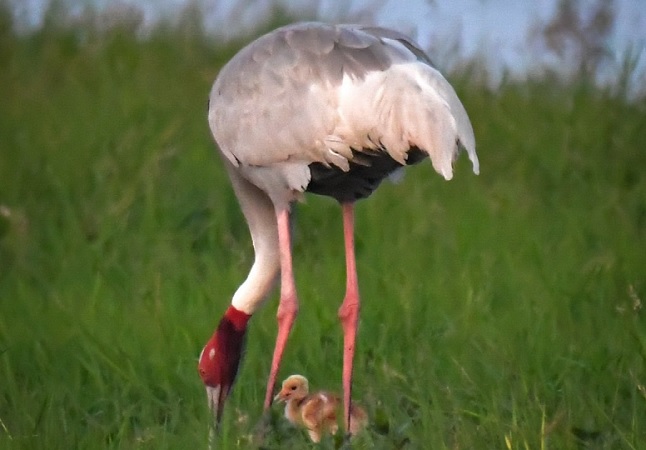

The Sarus crane, the tallest flying bird found predominantly in the Gangetic plains and recently facing threats to its survival, is part of an elaborate plan by the Uttar Pradesh government for its conservation as well as the preservation of its natural habitats.
The Yogi Adityanath government has laid out a detailed roadmap to establish a “Sarus Circuit” to promote the conservation of the Sarus crane, the state bird of Uttar Pradesh, and to boost eco-tourism. The circuit will be developed in the wetlands of Mainpuri and Etawah districts. It will include wetland areas in Kirthua, Sahas, Kurra Jarawan, Soj and Saman in Mainpuri, along with Sarsai Nawar and Parauli Ramayan in Etawah.
Besides protecting the Sarus crane, eco-tourism activities will also be developed within the Sarus Circuit. The main objective is to promote both Sarus conservation and wetland preservation while also encouraging local tourism. These projects are being implemented by the Forest Department through the UP Eco-Tourism Development Board.
The initiative is expected to create income opportunities for local communities and motivate people to protect the Sarus bird and wetlands. The Sarus crane, known as the tallest flying bird in the world, is the state bird of Uttar Pradesh. Its habitat and breeding grounds are mainly found in the wetlands of Mainpuri, Etawah, Etah and Aligarh. Keeping this in view, the state government is developing the Sarus Circuit for its conservation.
Under this initiative, the Forest Department, through the UP Eco-Tourism Development Board, is working to conserve shallow water bodies, ponds and wetlands in the region and make them more suitable habitats for Sarus cranes. At the same time, eco-tourism activities are also being developed in the area. As part of this development, facilities such as entrance gates, viewpoints, decks and boating spots, butterfly gardens, solar site lighting, interpretation centres and parking areas will be created within the Sarus Circuit.
Additionally, information centres, eco-toilet blocks, interactive signage, food kiosks and shops for ODOP products and souvenirs will be established for tourists. These facilities will provide visitors with an opportunity to observe and understand the natural habitat of the Sarus crane.
This initiative by the Yogi government will not only ensure the protection of the Sarus crane and other birds such as the grey heron and the open-billed stork but will also strengthen the conservation of wetlands in the region. It will help increase groundwater levels, reduce the impacts of global warming and contribute to sustainable development.
The development of eco-tourism activities is expected to generate income and employment opportunities for local communities. It will also increase environmental awareness and sensitivity towards nature among both residents and visiting tourists.